There is something irresistible about a movie that begins with a wedding (think of “The Godfather”), and there are few movie weddings as beautiful as the one at the start of “Mother of George,”Andrew Dosunmu’s gorgeous and delicate new drama. The party, a swirl of color, music and sentiment, observed with an eye for telling details of behavior, sets the tone — exuberant, dignified, a little bit anxious — for what is to follow.
Friday, September 13, 2013


The curious world of Walter Potter – in pictures
Walter Potter (1835-1918) was an amateur taxidermist who built tableaux that became icons of Victorian whimsy.A new book by historian of taxidermy Dr Pat Morris and New York-based artist and curator Joanna Ebenstein seeks to preserve and celebrate the now-dispersed collection with new photographs of his best-loved works
The 100 greatest novels of all time: The list
From Don Quixote to American Pastoral, take a look at the 100 greatest novels of all time
 |
| The greatest novel of all time? ... windmills in La Mancha feature in Miguel de Cervantes' novel Don Quixote. Photograph: Victor Fraile / Reuters |
1. Don Quixote Miguel De Cervantes
The story of the gentle knight and his servant Sancho Panza has entranced readers for centuries.
2. Pilgrim's Progress John Bunyan
The one with the Slough of Despond and Vanity Fair.
3. Robinson Crusoe Daniel Defoe
The first English novel.
4. Gulliver's Travels Jonathan Swift
A wonderful satire that still works for all ages, despite the savagery of Swift's vision.
Jonathan Franzen: what's wrong with the modern world
While we are busy tweeting, texting and spending, the world is drifting towards disaster, believes Jonathan Franzen, whose despair at our insatiable technoconsumerism echoes the apocalyptic essays of the satirist Karl Kraus – 'the Great Hater'
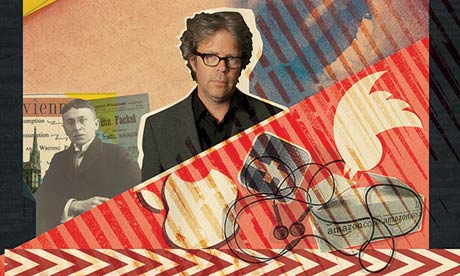 |
| Jonathan Franzen confesses to 'feeling some version of [Karl Kraus's] disappointment when a novelist who I believe ought to have known better succumbs to Twitter'. Illustration: Mark Lazenby |
Karl Kraus was an Austrian satirist and a central figure in fin-de-siecle Vienna's famously rich life of the mind. From 1899 until his death in 1936, he edited and published the influential magazine Die Fackel(The Torch); from 1911 onward, he was also the magazine's sole author. Although Kraus would probably have hated blogs, Die Fackel was like a blog that everybody who mattered in the German-speaking world, from Freud to Kafka to Walter Benjamin, found it necessary to read and have an attitude toward. Kraus was especially well known for his aphorisms – for example, "Psychoanalysis is that disease of the mind for which it believes itself to be the cure" – and at the height of his popularity he drew thousands to his public readings.
The thing about Kraus is that he's is very hard to follow on a first reading – deliberately hard. He was the scourge of throwaway journalism, and to his cult-like followers his dense and intricately coded style formed an agreeable barrier to entry; it kept the uninitiated out. Kraus himself remarked of the playwright Hermann Bahr, before attacking him: "If he understands one sentence of the essay, I'll retract the entire thing." If you read Kraus's sentences more than once, you'll find that they have a lot to say to us in our own media-saturated, technology-crazed, apocalypse-haunted historical moment.
Here, for example, is the first paragraph of his essay "Heine and the Consequences".
"Two strains of intellectual vulgarity: defenselessness against content and defenselessness against form. The one experiences only the material side of art. It is of German origin. The other experiences even the rawest of materials artistically. It is of Romance origin. [Romance meaning Romance-language — French or Italian.] To the one, art is an instrument; to the other, life is an ornament. In which hell would the artist prefer to fry? He'd surely still rather live among the Germans. For although they've strapped art into the Procrustean Folding Bed of their commerce, they've also made life sober, and this is a blessing: fantasy thrives, and every man can put his own light in the barren windowframes. Just spare me the pretty ribbons! Spare me this good taste that over there and down there delights the eye and irritates the imagination. Spare me this melody of life that disturbs my own music, which comes into its own only in the roaring of the German workday. Spare me this universal higher level of refinement from which it's so easy to observe that the newspaper seller in Paris has more charm than the Prussian publisher."
First footnote: Kraus's suspicion of the "melody of life" in France and Italy still has merit. His contention here – that walking down a street in Paris or Rome is an aesthetic experience in itself – is confirmed by the ongoing popularity of France and Italy as vacation destinations and by the "envy me" tone of American Francophiles and Italophiles announcing their travel plans. If you say you're taking a trip to Germany, you'd better be able to explain what specifically you're planning to do there, or else people will wonder why you're not going someplace where life is beautiful. Even now, Germany insists on content over form. If the concept of coolness had existed in Kraus's time, he might have said that Germany is uncool.
Subscribe to:
Posts (Atom)